


Do You Know How Much Tax Is in the Price of a Litre of Petrol, a Bottle of Slivovitz or a Packet of Cigarettes? You Will Be Surprised.
When you buy ordinary goods, about a fifth of the price is tax. For a bottle of slivovitz and a litre of petrol it is almost half, and for a packet of cigarettes more than eighty per cent. Yet the tax you pay at the till was paid to the state by someone else entirely, long before you walked into the shop.
Value added tax enters the price of every product. The seller adds it to the price, collects it from the customer and pays it to the state. From its profit, it then also pays income tax. Every businessperson knows this.
For the three groups of products we will look at, there is an additional layer. Mineral oils – i.e. petrol and diesel – tobacco products and alcoholic beverages are subject to excise duty. So are electricity, coal and natural gas. This duty is not tied to the value of the goods but to their quantity: per litre of pure alcohol, per thousand litres of petrol, per thousand cigarettes.
It arises when the goods leave the duty suspension arrangement, usually when they leave the tax warehouse for the first customer.
The order matters more than it seems. Excise duty is added to the price of the goods, and value added tax is calculated only on the amount thus increased, because the VAT Act includes other taxes relating to the goods in the taxable amount. The state therefore also taxes its own tax.
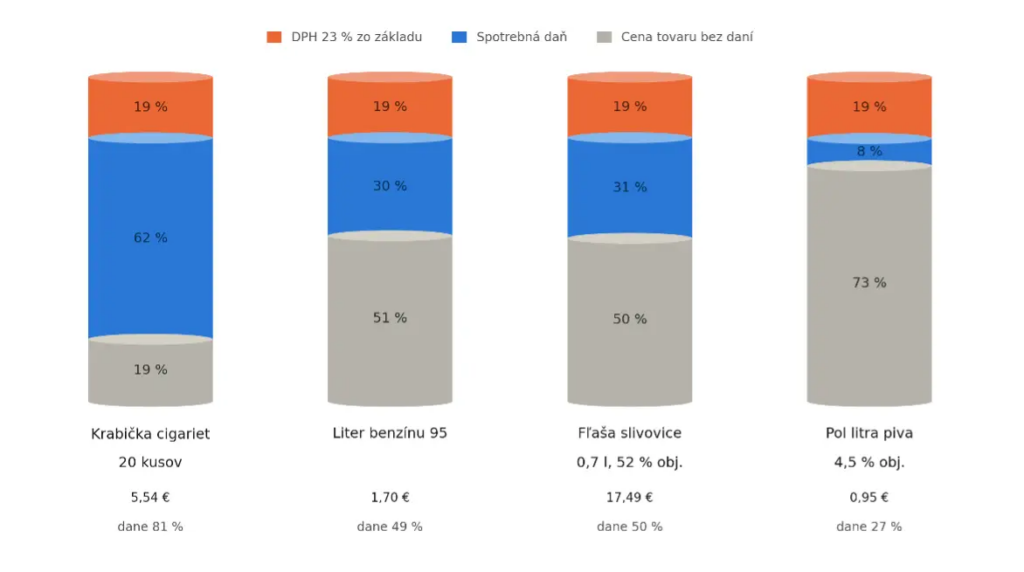
A litre of petrol shows this most quickly. At an average price of EUR 1.701, excise duty accounts for 51.4 cents and value added tax for another 31.8 cents. That leaves 87 cents for the fuel, transport, operating the filling station and the margin of the entire chain. Taxes make up 49 per cent of the price.
A 0.7-litre bottle of slivovitz with an alcohol content of 52 per cent – the kind commonly sold in Slovakia – carries excise duty of EUR 5.43, since the standard rate on spirits is EUR 1,490.40 per hectolitre of pure alcohol. At a price of EUR 17.49, VAT of EUR 3.27 is added, and taxes make up almost fifty per cent. A bottle of spirits and a litre of petrol are therefore taxed almost equally.
This is because the duty does not follow the price of the bottle, but the alcohol in it. A bottle of absinthe of the same size at seventy per cent therefore carries EUR 7.30, a third more, even though the rate is the same. Half a litre of beer at 4.5 per cent alcohol carries eight cents, and still wine nothing at all, as the law sets no rate for it.
A packet of cigarettes is in a different league. At the weighted average price set by the Financial Directorate, it costs EUR 5.54. Excise duty accounts for EUR 3.44 of this, because it is calculated as a fixed amount per piece plus a quarter of the price. VAT adds another EUR 1.04. The state receives EUR 4.48, leaving the manufacturer, the wholesaler and the tobacconist with EUR 1.06 between them. Taxes make up 81 per cent of the price.
One figure confuses even experienced people, so allow me a short maths interlude. The seller calculates from the bottom up: to the price before tax, say one hundred, they add 23 and arrive at 123. The customer reads the same thing from the top down: of those 123, 23 is tax, i.e. 18.7 per cent of the amount on the receipt. The rate is still 23 per cent; we are simply measuring from a different base. That is why our charts do not state that VAT is 23 % of the final price, even though the VAT rate is 23 % – it would not be true.
For businesses, this has a consequence the customer does not see. The duty is not paid by whoever buys the goods, but by whoever released them for consumption, by the 25th day of the following month. A carton still sitting on a pallet has already been paid for to the state. Anyone operating a tax warehouse also provides a guarantee equal to the duty for an average month. For a commodity where duty makes up four fifths of the price, this is not an administrative item but a credit line that the company finances itself.
And here the topic turns to something more serious. Anyone who evades the duty gains not a tenth of the margin, but price room equivalent to half the price, or approaching four fifths of it. An honest importer or distributor has nothing to compete with. The law therefore deals with the burden of proof harshly. The tax liability arises on the very day goods are found with a person who cannot prove their origin or how they were acquired.
In summary, for both sides of the counter: with petrol, spirits and cigarettes, the consumer is mostly paying not for the goods but for tax. The business pays it before its customer pays, ties up additional capital in the guarantee and, if its records fail, risks being assessed the same tax a second time, a fine and the seizure of goods. With such a share of taxes, one thing is enough to bring down an otherwise healthy company: the state failing for several months to refund what it is entitled to. That will be the subject of the second part next week.