


A Withheld Tax Refund Is the Strongest Lever the State Has over a Company.
The Supreme Administrative Court has already ruled that the Slovak compensation rules are contrary to EU law.
In the first part, we calculated that for petrol, spirits and cigarettes, tax accounts for between half and four fifths of the price. When the state stops refunding this money to a company, the company is left without liquidity even if it has done nothing wrong.
The mechanics are simple and harsh. If the tax office starts a tax audit within the time limit for refunding an excess VAT deduction, it will refund it only within ten days of the end of the audit, and in the amount it determines itself. The time limit for the audit is a maximum of one year, but it does not run while the audit is suspended, and it can be suspended, for example, for the duration of an international exchange of information. One year is a ceiling that can lawfully be stretched to two.
From our practice: at an oral hearing on the refund of an excess VAT deduction, I heard a tax official say: “But VAT belongs to the state, why does it bother you so much that we withheld it…?” I had to explain to her how VAT works: that the client operates on a 5 % margin on resale, and that when buying the goods it had paid the full VAT (then still 20 %) to the supplier as part of the price. The answer was: “Ohhh, I didn’t know that…”
Leaving aside this example of how far decisions about a company’s money can be from the reality of its business, the mechanism for withholding excess VAT deductions described above makes clear how severe an intervention this measure is for a business, and how sensitively and judiciously the state should apply it.
With excise duty, it is even harsher and far less well known. The customs office refunds the duty within 30 days of the tax return being filed, provided all conditions are met. If it starts an audit within that period and the duty established does not differ from the duty declared, it refunds it within 15 days of the end of the audit. If it does differ, it refunds it only within 15 days of the date on which the decision becomes final – after the entire assessment and appeal round – and withholds it throughout that whole period.
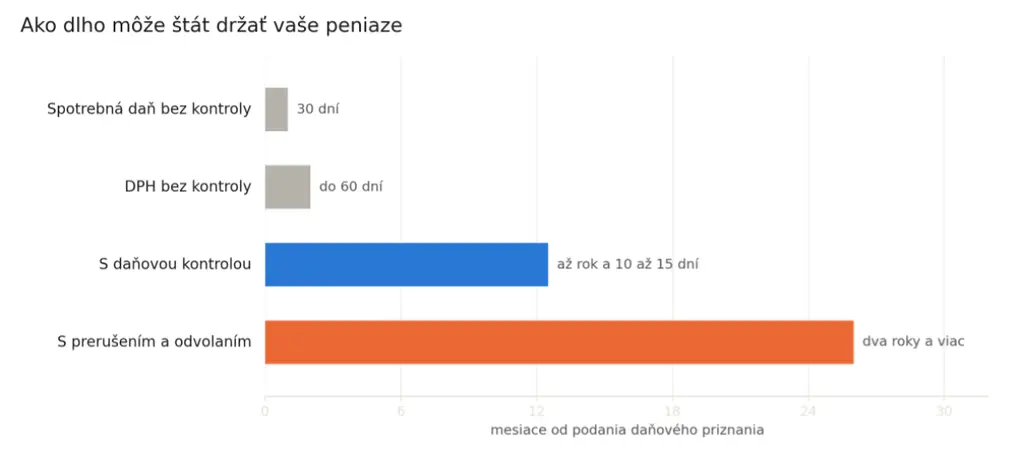
The point is that withholding a refund, whether of an excess VAT deduction or of excise duty, during an audit can very quickly bring a business to an end through lack of liquidity. The most extreme cases are companies trading in excise goods, where a possible withholding of both VAT and excise duty accumulates. Such a company may not survive even the first quarter of an audit. And this is a raised finger above all for the state: whether and how (i.e. for which tax period, for which transactions and for how long) to withhold VAT and excise duty so as to achieve the purpose of the law while at the same time keeping business activity in this sector alive.
Criminal proceedings have shown that this power has a real market price. In one case that has been finally concluded, the director of a tax office agreed, in exchange for ten per cent of the refund paid out, to arrange that no audit would take place and the money would be paid. One tenth of the refund was the price of certainty that the state would not touch the company’s liquidity. Had the company not bought it, it would have borne that risk in full – and would have borne it even if it had done nothing wrong. Further ongoing proceedings show that there are more such suspicions. Until they are concluded, the presumption of innocence applies. But we do not need their outcome to see the problem. A power that had a black-market price of ten per cent of the refund must have strict limits in the law and must be applied equally to everyone. Otherwise, it becomes a tool for handing out competitive advantages – the exact opposite of what the law granted it for.
Against this background, the Court of Justice of the European Union, in its order of 21 October 2015 in Case C-120/15 Kovozber, which arose from a Slovak reference, held that a taxable person is entitled to default interest if the excess deduction was not refunded within a reasonable period because of a tax audit, and that national legislation may not deprive it of reasonable compensation for the loss thus incurred.
Previously, there was no compensation at all for withholding in Slovakia. Following this ruling, compensation was introduced at 1.5 % (or twice the ECB rate, if higher) from the sixth month of withholding. But even that did not stand. Compensation is therefore in flux today, and we are following these developments closely. We assert it on behalf of our clients in proceedings before the tax and customs authorities, and at the judicial and constitutional level we work with a law firm so that clients receive adequate and fair compensation for this extremely serious interference with their business. In its judgment of 21 July 2025 in case 2Sžfk/42/2020, the Supreme Administrative Court annulled the Financial Administration’s decisions on compensation and held that Section 79a of the VAT Act is contrary to EU law as regards both the period and the amount. Withholding without compensation is permissible only for five months from the expiry of the deadline for filing the return for the period in which the deduction arose, not for six months on top of the standard period. And the annual rate of 1.5 % % cannot stand where the market interest rate on short-term loans to non-financial corporations is higher. In that case, the provision is disapplied and compensation is calculated at the market rate. Even so, we do not consider this decision to provide adequate and fair compensation; we are seeking higher compensation, and from an earlier point in the withholding period. In one of the cases, a decision of the Constitutional Court of the Slovak Republic is awaited.
And here is the direct financial consequence. Anyone who has received compensation calculated at a rate of 1.5 % in recent years has almost certainly received less than they are entitled to. The difference can be claimed, and with the sums involved here, it is no small change.
In practical terms, three things follow. Plan your liquidity for a scenario in which the refund does not arrive, potentially for as long as a year – i.e. with a credit line agreed in advance, not one sought in the third month of an audit. Contracts with business partners should address the financing of tax between its payment and its collection, evidence that the tax has been correctly claimed by the taxable person, any guarantees, and also what happens to payment terms when a refund is withheld. And the length of an audit should depend on how quickly you can prove the origin of the goods and the supply chain; a documentary trail prepared in advance should shorten the audit by months – and months here mean money.
In summary: the tax authority may withhold a refund if it starts a tax audit within the time limit for the refund. It must refund it within ten days of the end of the audit for VAT and within 15 days for excise duty, or, if its findings differ, only after the decision has become final. For withholding beyond a reasonable period, the company is entitled to compensation, which must be calculated at the market rate (according to the latest ruling of the Supreme Administrative Court), not at 1.5 % (or twice the ECB rate, if higher). The judicial level of the dispute belongs to a lawyer; in proceedings before the tax and customs authorities, we represent clients ourselves.
If you would like to go through a past case of withheld tax or set up preventive measures in case of a tax audit, including the withholding of a refund, we will be happy to assess your situation.